
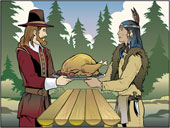
 Every American school child is taught that when the Pilgrims landed at Plymouth they had a very hard winter and many died of sickness and hunger. The Indians helped them out showing them how to improve things by using beaver pelts for clothing and how to get crops to grow better. We are taught that they had a thanksgiving feast to celebrate the help given by the Indians. That is about as far as the school books go.
The most interesting and educational part of the Pilgrims story is completely omitted from most history lessons. It seems that even with all the help from the Indians the settlers still were not doing very well. The problem was not the bad weather or the bad soil in Plymouth.
The problem was that the Pilgrims were organized into a huge socialist commune. The land was held in common and the food grown on the land was held in a common storehouse and shared equally among the Pilgrims. Governor Bradford, who had become the leader of the group, noticed that people were not working hard to produce food to put in the warehouse. When he listened, he discovered that people were not willing to work hard when the results of their labor were shared in common. In today’s terms he found that people simply quit working when the fruits of their labor were “redistributed.” Governor Bradford took bold action. He divided the land up among the pilgrim members and made each pilgrim responsible for growing food and feeding himself with the fruits of his own labor. Furthermore he was able to get the group to go along with his idea. The results were swift and startling. They produced more food than anyone had ever imagined they could and the colony became prosperous. The most interesting thing was that the Pilgrims, and Governor Bradford in particular, were able to observe that the socialist organization of their community was not working and abandoned it after only a year or so for free-market farming. What allowed the pilgrims to be able to see the problem and correct it within a short length of time? After all, the communists had this problem for about seventy years and didn’t do a whole lot about it.
A smart aleck response to this question would be "Since Harvard hadn’t yet been founded Bradford and the Pilgrims hadn’t been indoctrinated in socialism in Massachusetts."
A more serious answer to the question is that without strong coercion to force people to maintain the socialist structure, the pilgrims naturally reverted to a free market capitalist way of doing things.
Whenever there is an absence of coercion, free market capitalism automatically becomes the natural order of things. If you look at the socialist activities of our government today, you come to the conclusion that people have to be coerced into taking part in all of them. For example, who with an age under 45 and an IQ over 90, would continue to take part in the Social Security system if they had a choice?
If people were free to opt out of government programs, most of the programs would disappear. Whenever you hear about hunger in the world the chances are that is caused by socialistic agricultural economic practices.
They always blame the famines on the weather.
For example, the former Soviet Union was one of the world’s biggest exporters of grain before the communists restructured the farm economy. After that they had “seventy years of bad weather.”
Soviet farmers carried on a secret market farming economy to keep from starving. It is estimated that about 30 percent of Soviet food was grown secretly on 1 to 2 percent of their land.
Returning to the lesson of the Pilgrims, American schoolchildren should be taught what happened at Plymouth so they can help the world avoid making the mistake of adopting socialism over and over.
When I was in school, we were taught this history. You can’t read about this part of history in our present school books.
A recommended reading is in Clarence Carson’s "A Basic History of The United States, Volume 1. The Colonial Experience."
As we sit down to our thanksgiving dinners keep in mind that if people the world over would learn and act on the lesson of the pilgrims virtually everybody could have a good thanksgiving dinner.